
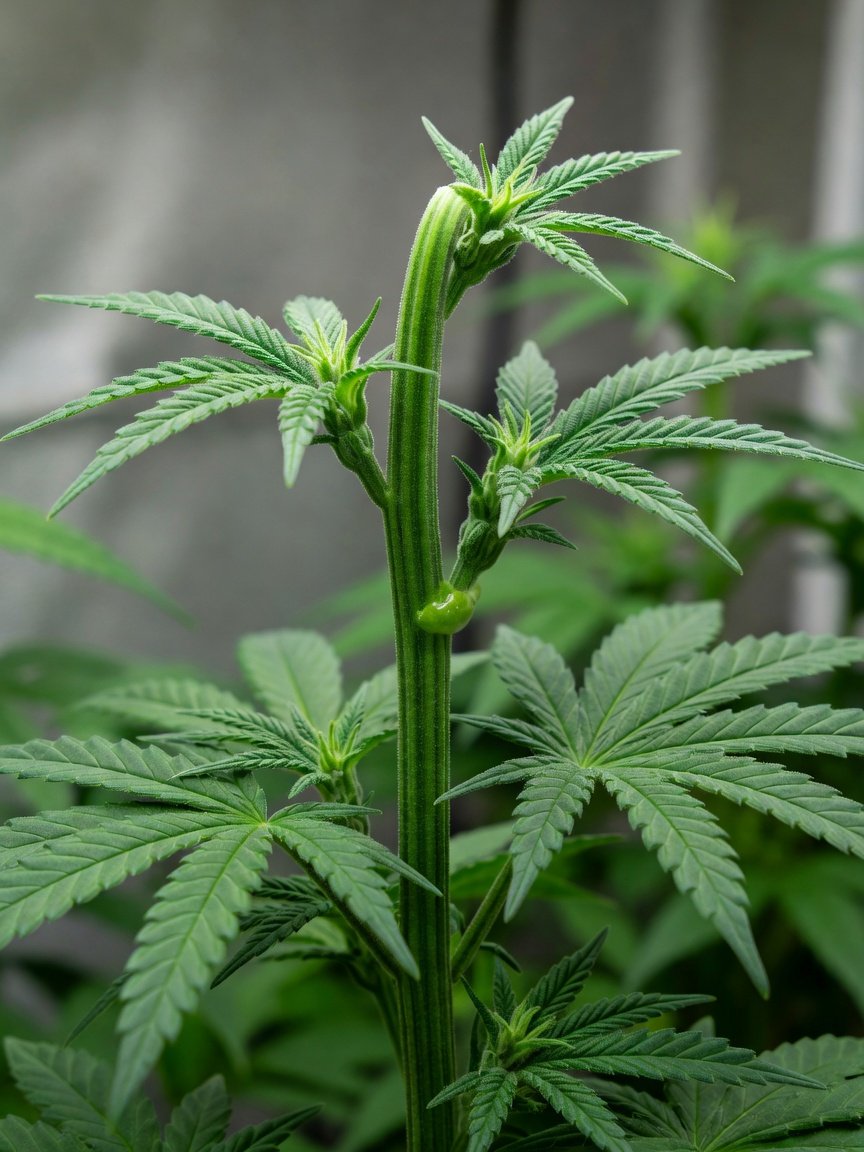
Tall photoperiod plants often race a single leader toward the light while side branches lag a node or two behind. Knuckling, sometimes called a soft supercrop pinch, is a high-stress stem bend that crushes the inner pith without removing the tip and without tying the plant into a net. The goal is a swollen knuckle, a tougher branch, and a temporary pause at the top so lower colas catch up. It is not low-stress training, not topping, and not a SCROG. Those methods either avoid tissue damage, delete the apex, or use a screen to hold shoots flat. Knuckling does one job: a controlled internal crush, a bend, and a heal window you can actually schedule.
Home growers reach for it when a photoperiod is already too tall for the tent, the main stem is still green, and they want even tops without cutting the plant or stringing a net across the canopy. Done on the right day, the outer skin stays intact, sap keeps moving, and the branch firms into a callused elbow that often supports more weight than the original straight stem. Done on the wrong day, the sheath splits, the bend rots, or flower stretch locks in an uneven canopy you can no longer correct. This guide stays on that narrow technique: when to pinch, how the stem should feel, what recovery looks like, where early flower draws the line, and why autoflowers are a poor fit.
What knuckling actually changes in the stem
A healthy cannabis stem is a tube. Soft inner tissue sits inside a tougher outer sheath that carries water and sugars. Knuckling targets the inner core. You soften that core until the stem will fold, while the sheath stays continuous so the branch does not dry out or snap off. The plant reads the crush as mechanical stress. Growth at that tip slows for several days, auxin flow is interrupted at the bend, and side shoots that were shaded get a chance to rise. Over the following week the damaged zone swells into a knuckle of callus. That swelling is the point of the method, not a cosmetic side effect.
Plant science has long described this kind of response. Repeated or sudden mechanical stress can thicken stems, a pattern discussed across research indexed by the National Center for Biotechnology Information. Mainstream horticulture uses related ideas when trainers bend soft growth to fill space without cutting the tip; the Royal Horticultural Society covers training and bending as standard garden practice. Cannabis knuckling is simply a sharper, one-session version of that idea, reserved for photoperiod plants that can sit in vegetative growth long enough to heal.
Keep the boundary clear. Low-stress training pulls a stem over days with ties and never aims to crush tissue. Topping removes the growing tip so two shoots replace one. A net holds many branches in a flat plane. If you are already tying, cutting, or screening, you are not knuckling. Mixing them on the same stem in the same week stacks stress and makes heal time impossible to read.
When to pinch tall photoperiod stems
The useful window is late vegetative growth, after the plant has a real stem and before you flip to 12/12. Most indoor photoperiods are ready once the target branch is about as thick as a pencil, still bright green, and bends a little under finger pressure without creaking. That is often week four to week seven from seed for vigorous plants, earlier for fast hybrids and later for slow, woody cultivars. Count nodes, not calendar days. A short, soft seedling has nothing to knuckle. A brown, lignified stem from a long veg will crack instead of fold.
Pinch only the shoots that are clearly ahead of the canopy. One dominant cola, or two, is enough. Working every branch on the same afternoon turns a height correction into a stall. Leave at least one untouched path of growth so the plant keeps feeding roots while the bent sites recover. If you plan to flip soon, knuckle at least ten to fourteen days before the light change. The bend should already be firm, and new leaves above it should have regained turgor, before nights lengthen.
Height problems in tight rooms are common, and some growers solve them with racking rather than stem work. If your limit is vertical space rather than an uneven top, a short look at vertical cannabis growing for home setups will show when a different layout beats another round of high-stress bends. Knuckling is for cola balance and stem toughness, not a substitute for a tent that is simply too short.
Time of day and plant condition
Pinch in the morning, after lights have been on long enough for leaves to look perky, and after a normal watering the day before. A drought-stressed stem is brittle. A freshly soaked stem can be too turgid and split along the sheath. Skip any plant that is already pale, root-bound, or fighting pests. High-stress bending borrows energy from growth. A plant that is only just holding on will spend that energy on survival and may stall the knuckle instead of swelling it.
How the stem should feel under your fingers
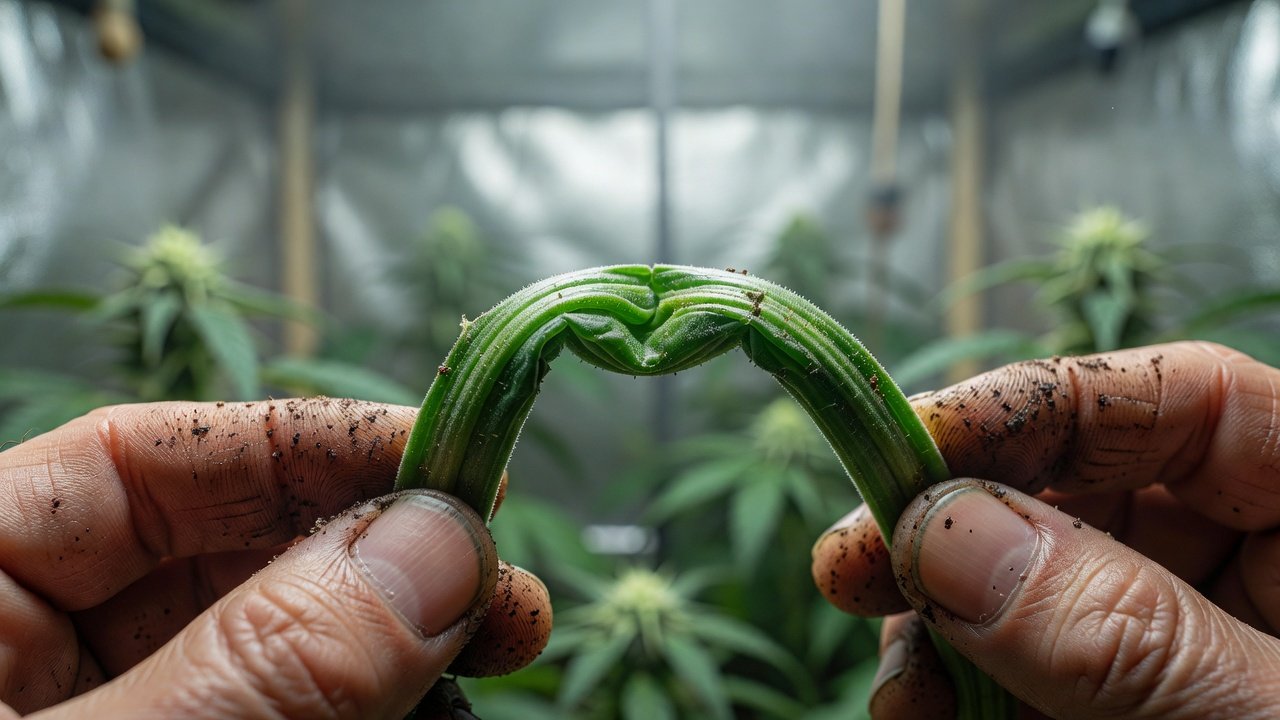
Roll the chosen internode gently between thumb and forefinger, working a short zone rather than a single pinpoint. You are listening with your hands for a soft give, then a muted crush, like snapping the strings inside a green bean while the skin stays whole. A good stem feels cool, slightly springy, and moist. It should not feel hollow, glassy, or fibrous. If it creaks, stop. If the skin whitens in a long split, stop. The correct end point is a limp bend of roughly 70 to 90 degrees, with the outer tissue wrinkled but closed, and a faint dampness at most, not a running wound.
Support the stem on both sides of the pinch so the force stays in the core and does not lever the branch off the main stalk. Bend in the direction you want the cola to travel, usually outward and slightly down, so the tip sits near the height of the next-best branches. Do not twist the sheath into a spiral. A twist tears vascular tissue even when the outside still looks intact, and those bends heal slowly or not at all.
After the fold, the tip may droop for the rest of the day. That droop is expected. What you should not see is a clean break, a hanging flap of skin, or a stem that feels mushy within hours. If the sheath did split, align the edges, keep the site dry, and do not pinch that branch again. A small clean split can callus. A shredded one often dies back to the next node.
Recovery signs and realistic heal time
Read the bend on a schedule, not by hope. In the first 12 to 24 hours the tip often looks tired and the leaves above the knuckle may angle down. By day two or three the site should feel thicker than the stem on either side, and the colour should stay green or turn a slightly paler green, not brown or grey. By day five to seven most healthy photoperiods have a firm elbow and the tip has started to turn upward again. Full structural recovery, meaning you can bump the branch without the bend collapsing, commonly takes 10 to 14 days. Some vigorous hybrids firm up in a week. Slow, indica-leaning plants in cool rooms can need the full fortnight.
Good signs are a dry surface, a swelling knuckle, upright new growth, and no smell other than the plant’s normal scent. Bad signs are a spreading brown streak, a soft wet patch, leaves above the bend yellowing while the rest of the plant stays green, or a tip that never lifts after a week. A failed knuckle will not “catch up” in flower. Cut back to healthy tissue if the stem is clearly dying, and leave the rest of the plant alone.
Heal speed tracks grower basics more than any secret pinch. Steady temperatures, moderate airflow across the wound, and a root zone that is neither bone dry nor sitting in runoff all matter. Very humid rooms slow drying at the crease and invite stem rot. If your space already runs wet, pair this technique with the environment advice in the high-humidity cannabis seed and care guide rather than knuckling a canopy that never quite dries. Vigour matters too. Plants grown with a living soil or a steady organic feed usually swell callus faster than starved ones. The organic cannabis growing guide from seed to harvest covers that foundation; knuckling will not compensate for a weak plant.
Do not feed a heavy bloom booster to “push recovery,” and do not knuckle the same internode twice. One clean crush is the treatment. A second pinch on a half-healed site usually finishes the split the first pinch avoided. If a neighbouring branch later outgrows the canopy, choose a fresh internode farther out, and only if you still have vegetative time left.
Early-flower limits: where the method stops
Photoperiod stretch in the first two weeks of 12/12 is exactly when uneven colas become obvious, and exactly when knuckling gets risky. Stems elongate quickly, internodes are softer in some cultivars and suddenly brittle in others, and the plant is dividing energy between stretch and the first flower sites. A knuckle made on day one or day two of flower can still firm before buds gain weight, but only on one or two stems, and only if vegetative recovery habits are already in place. Treat that as an emergency height correction, not a planned canopy style.
After about day 14 of flower, stop. Wound closure slows once the plant is stacking calyxes. A fresh bend can stall the cola above it, open a path for botrytis in dense rooms, and arrive too late to even the canopy anyway, because flowering sites are already set. Bud weight will also lever a soft knuckle open. If you missed the vegetative window, use ties or stakes on intact stems. Do not invent a late-flower version of this technique. Early flower is the last edge, not an open season.
Sex expression does not change the rule, but you should know which plants are worth the stress. If you are still sorting males from a seed run, settle that before you pinch keepers. A short vegetative sex check, as outlined in existing early-sexing practice, saves you from healing a branch you will cull. Knuckling a male “to see how it bends” wastes the only heal window your females may need.
Why autoflowers are a poor fit
Autoflowers do not wait. Their vegetative phase is a short, fixed runway, and flower starts on the plant’s clock whether the stem has callused or not. A knuckle needs roughly one to two weeks of low demand to swell and reorient. On an auto, that same fortnight is often the entire stretch into early bloom. The crush then lands as stunting rather than training. Yield drops because the plant cannot be held in veg until the elbow firms, and a paused top on an auto rarely hands its lead to side branches in time for them to build real colas.
Auto stems are also frequently still thin when flower sites appear. Thin tissue crushes through instead of folding, so the “intact sheath” standard is harder to hit. If an auto is too tall, gentle tying started early is the matching tool. High-stress pith crushing assumes spare time. Autos do not have it. Treat that as a hard exclusion, not a challenge for experienced growers.
Do and don’t checklist
- Do knuckle only green, pliable photoperiod stems in late veg, ten to fourteen days before flip.
- Do pinch until the inner core gives and the sheath stays closed, then bend once to about a right angle.
- Do wait for a firm, dry swelling and an upright tip before you change the light schedule.
- Do limit early-flower pinches to the first day or two, and only on a stem or two.
- Don’t knuckle seedlings, woody brown stems, drought-stressed plants, or anything already in mid flower.
- Don’t twist the sheath, pinch the same site twice, or combine the bend with topping or a net on that branch the same week.
- Don’t use the method on autoflowers. Their clock will not give the heal time the knuckle requires.
- Don’t keep a brown, soft, or foul bend. Remove the failed section and protect the rest of the plant.
Using knuckling as a planned finish, not a rescue habit
The growers who get even colas from this method decide the bend before the plant is desperate. They pick the leaders, feel for a moist green internode, crush the core without opening the skin, and then do nothing dramatic for two weeks except keep the room stable. The knuckle swells, the tip lifts, side branches meet it, and the canopy enters flower at one height. That sequence is the whole technique.
If the stem feels wrong, the calendar is already in flower, or the plant is an auto, the correct advanced move is to leave it alone. High-stress stem bending earns its place only when heal time is real and the sheath can survive the pinch. Used that way, knuckling toughens branches and levels colas without a cut tip and without a screen. Used as a last-minute wrestle with a woody or flowering stem, it costs more growth than it saves.