
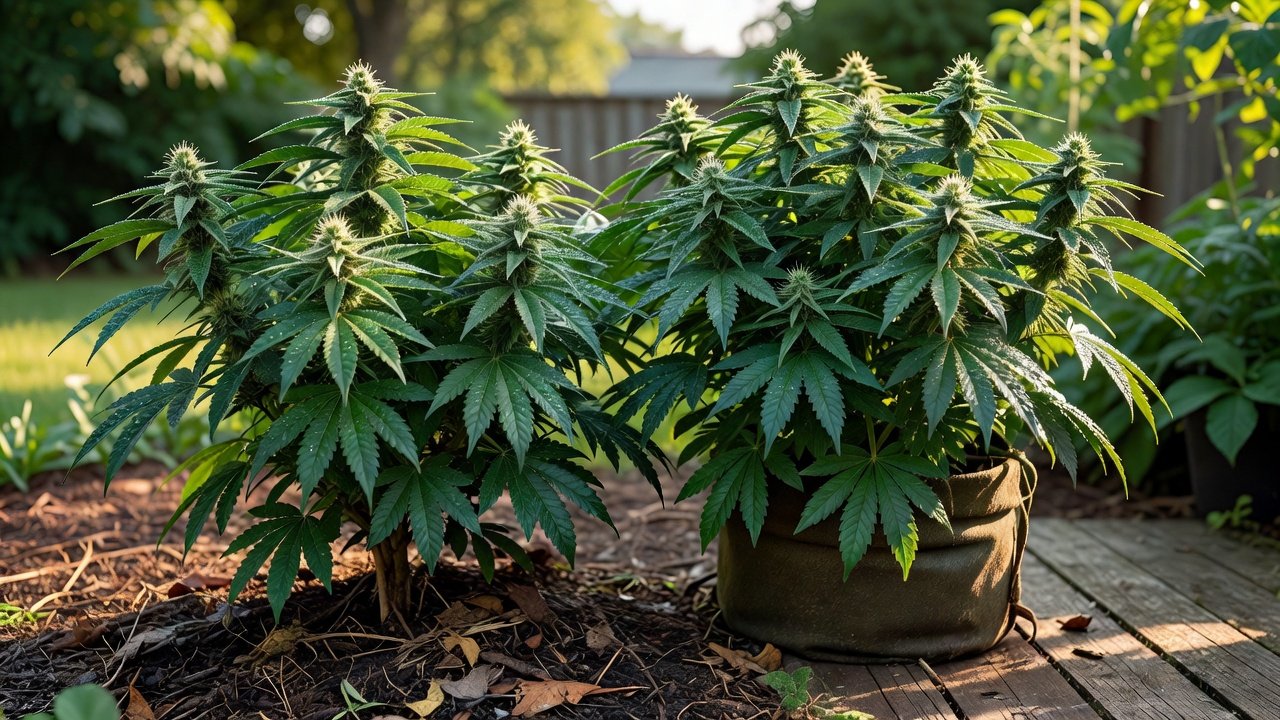
Outdoor cannabis does not reward the setup that looks tidiest on a Saturday morning. It rewards the placement that keeps roots oxygenated, watered, and cool enough to feed a plant through the longest days of the year. Backyard and patio growers usually face a practical fork: sink plants into native soil, or keep them in pots, fabric bags, or rigid containers. Both can finish strong. Both can also waste a season if the site, the climate, and the container size fight the plant.
This is an outdoor placement decision, not a rerun of indoor soil-versus-coco or soil-versus-hydro arguments. You are choosing how much earth the roots may explore, how fast water leaves the root zone, whether you can roll a plant under cover before a hail cell arrives, and how much heat the growing medium will store against a wall or on paving. Native soil, including open-bottom raised beds that connect to the ground, lets roots leave the amended pocket. Pots keep the entire system inside a volume you mix, move, and eventually empty. Control is why containers save patio grows. That same limit is why pot plants often drink faster, finish smaller, and cook their roots on hot stone.
Match the method to space and weather before you buy seed or dig a hole. A legal home garden with deep loam and a long season is a different problem from a rented balcony with six hours of sun and an early frost. The comparisons below cover root volume, drainage, mobility, heat stress, yield potential, and bad-weather handling, then close with a short checklist.
Root volume decides how hard the plant can work
In native soil, a vigorous outdoor plant can send roots well beyond the planting hole if the ground is not compacted, waterlogged, or sealed by a hardpan. That extra volume is a buffer. Roots find moisture after a dry week, pick up minerals from a wider area, and anchor the plant when wind loads a heavy cola. A generous planting hole still matters. Dig wide, loosen the sides so roots are not trapped in a glazed pot-shaped cavity, and amend only enough to improve the pocket without creating a sponge that stays wet while the surrounding yard stays dry.
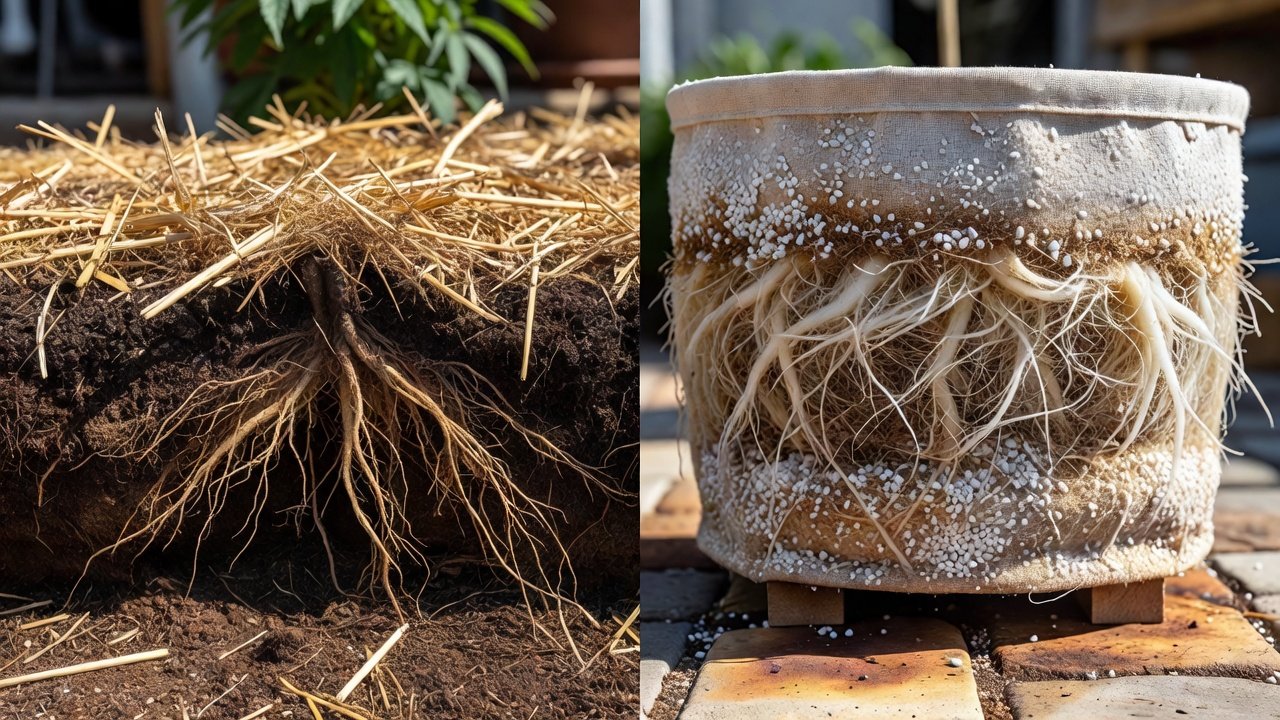
Containers invert that logic. The pot is the entire world. A 10- to 15-gallon pot can carry a modest patio plant. A full-season outdoor cultivar with room to veg often wants 25 to 50 gallons or more if you expect a garden-bed result. Fabric pots air-prune circling roots and usually beat cheap thin plastic for oxygen, but they do not invent litres that are not there. Undersized pots force constant feeding, earlier flowering stress, and a plant that tips in wind because the canopy outweighs the root ball.
Starts raised indoors need a gradual move either way. A soft indoor plant dropped into cold ground or a sun-baked pot on day one stalls, and sometimes dies back. Follow a real hardening schedule, as covered in how to harden indoor cannabis for outdoor transplant in 7–14 days, then plant into moist—not soggy—medium on a mild day. In native beds, mycorrhizal inoculant at transplant can help roots colonise beyond the hole; that biology is summarised in the site’s guide to mycorrhizal fungi for outdoor nutrient uptake, so there is no need to re-litigate the science here. In pots, the same inoculant helps, but it cannot compensate for a bag that is simply too small.
Drainage, watering rhythm, and what the ground already is
Drainage is where many backyard plans fail quietly. Cannabis roots want moisture and air in the same hour. Native clay holds water, warms slowly in spring, and can suffocate a transplant after one heavy rain if the hole was dug like a bucket. Sandy ground drains fast, leaches nutrients, and forces you to water more like a container grower even though the plant is “in the earth.” Before you commit a row, dig a test hole, fill it with water, and see whether it empties in hours or still sits full the next morning. The USDA Natural Resources Conservation Service publishes practical soil-health guidance at NRCS that is worth reading if you do not yet know whether your yard is loam, clay, or something in between.
Raised beds with open bottoms are a useful middle path when native soil is poor but not poisonous. You import structure on top and still let roots exit downward once they are established. Fully lined beds behave like giant pots: excellent if you designed the drainage, disappointing if the liner turns the bed into a bathtub.
Pots win on predictability. A quality mix with perlite, bark, or pumice drains even when the sky opens, provided the pot has real holes and is not sitting in a saucer of runoff. They lose on forgiveness. A fabric pot on a hot deck can go from moist to bone-dry between morning and late afternoon. That swing stresses roots, invites salt buildup if you feed heavily, and is the main reason patio plants look thirsty while the lawn still feels damp. Water containers until runoff appears, then let the top layer dry slightly before the next heavy soak. Do not keep them constantly wet just because the leaves droop at 3 p.m.—droop in heat is often a temporary water-transport lag, not a signal to flood the pot.
Mobility, heat stress, and bad weather
Mobility is the container’s unfair advantage, and it is not a small one. A plant on a wheeled saucer or in a fabric pot with handles can chase spring sun, leave a heat-reflecting wall, or roll under a porch when hail, tropical rain, or an early freeze is forecast. In-ground plants stay where you put them. If the only full-sun pocket is also the wind tunnel between two houses, native soil locks you into that compromise for the whole season. Patio growers with limited hours of light should treat mobility as a yield tool, not a convenience.
Heat stress flips the comparison. Dark plastic on concrete or composite decking can push root-zone temperatures well above what foliage enjoys. Roots slow down, beneficial biology struggles, and the plant drinks poorly even if the pot is wet. Fabric pots breathe and usually run cooler than thin black nursery pots, but they still heat up in full sun on stone. Native soil, especially under mulch, buffers temperature. The surface may bake; six inches down it stays far steadier. That buffer is one reason in-ground plants ride out a hot week with less drama, assuming you can actually irrigate them.
Mulch is the in-ground grower’s main heat and moisture tool. A layer of clean straw, wood chips kept off the stem, or living cover between rows cuts evaporation and softens soil temperature. Technique matters more than the product label; the site already covers mulching techniques for outdoor cannabis, including what to keep away from stems so you do not create a rot collar. Pots can be mulched too, with a thin layer, but the bigger fixes are shade for the container wall, a light-coloured outer pot, elevating the bag off hot decking, and refusing to park plants against south-facing masonry.
When the forecast turns ugly
Bad weather exposes the trade-off in a single afternoon. Containers can be grouped against a fence, covered with a breathable sheet, or moved indoors to a garage for a night of frost. They can also become sails. A tall plant in a light pot tips, snaps branches, and spills medium across the patio. Stake containers early, use heavier mixes or a brick in the base of very tall plants, and do not wait for the gust to test your knots.
In-ground plants resist tipping if roots have had time to anchor, which is another argument against planting into a slick, unloosened hole. They cannot dodge hail or a week of cold rain sitting on clay. Low tunnels, temporary hoop frames, and good site drainage are the realistic answers. Check a trusted forecast before you commit to an uncovered week of flowering; the National Weather Service at weather.gov is a better planning source than a single app notification. In short northern seasons, a pot you can slide under cover may beat a perfect bed that still gets frozen in late September. Pair that mobility with a cultivar that finishes on time rather than hoping a long-season plant will ignore the latitude.
Yield potential is real, but it is not automatic
All else equal, native soil with decent structure, full sun, and a long enough season produces the larger plant. Root volume, temperature buffering, and access to a wider moisture reserve add up to more veg growth and heavier flower if you do not drown or starve the bed. “All else equal” is the catch. Compacted clay, a neighbour’s tree, or a bed that only sees sun after 4 p.m. will lose to a 40-gallon fabric pot on a bright balcony. Yield follows light and healthy roots, not the romance of planting in the ground.
Container ceilings are mostly self-imposed. Step up pot size, use a mix that holds water without sealing shut, and feed on a schedule instead of guessing from leaf colour alone, and patio yields can be impressive—just rarely equal to an unobstructed in-ground plant of the same cultivar with the same sun hours. Expect to water more often, watch salts, and accept that a missed weekend in July costs more in a pot than in mulched soil. If you travel, native soil with a simple drip line is more forgiving than five fabric pots that need a daily hand watering in a heatwave.
Side by side, the pattern is consistent. Root volume favours native soil and large open beds. Drainage favours a well-built pot or a sandy, well-structured bed, and punishes both clay holes and saucers left full. Mobility and storm dodging favour pots. Heat buffering favours mulched ground. Peak yield favours in-ground sun. Reliability on a patio, balcony, or rental with no digging rights favours containers every time.
Decision checklist by space and climate
Use this as a placement filter, not a scorecard you must win on every line. One hard constraint—no permission to dig, toxic fill, or a season that ends in early September—should outweigh three soft preferences.
- Deep, workable loam and legal garden space: choose native soil or an open-bottom raised bed. Amend the planting zone, mulch, and give roots a path out of the hole.
- Heavy clay or a yard that puddles: do not drop plants into unmodified holes. Build raised open beds, or use large pots. Standing water beats almost every other advantage of in-ground growing.
- Patio, balcony, deck, or rental: use the largest fabric or rigid pot you can move safely. Elevate it, shade the container wall, and plan wheels before the plant is top-heavy.
- Hot, reflective sites: prefer mulched native soil. If you must use pots, choose light colours or fabric, keep them off bare stone, and water in the morning so roots are not sitting in hot, stagnant medium overnight.
- Windy corridors: in-ground wins on anchoring once established. Pots need stakes, mass, and a windbreak. Do not use a tiny pot just because it is easier to carry home from the shop.
- Short northern seasons or frequent early frost: pots you can cover or roll under a roof often beat an exposed bed. Choose a fast-finishing cultivar and do not veg so long that the pot becomes impossible to move.
- Travel or irregular watering: mulched native soil with drip irrigation is safer than containers that crash in two hot days.
- Unknown urban fill, old paint debris, or contaminated ground: do not grow food or flower in that soil. Use clean potting mix in containers, or build beds with a proper barrier and imported medium.
A hybrid is often the honest answer. Keep mothers or late starts in pots you can protect, and put the main crop in the best in-ground sun you have. Or run one trial plant each way for a single season and keep notes on watering frequency, heat wilt, and finished weight. That experiment teaches more than any general rule, because your fence line, your soil, and your first frost date are local facts.
Place the plant where the season can finish
Native soil is the higher ceiling when the ground drains, the sun is real, and you can leave the plant in place. Pots are the higher floor when you need to move, when the yard is hostile, or when the only growing space is a patio that heats like a griddle. Root volume, drainage, mobility, heat, yield, and storm response all point the same direction once you describe the site honestly.
Decide before you sow. Match pot gallons to the cultivar’s veg time, or dig a hole wide enough that roots are not jailed in amended mud. Harden transplants, mulch what you cannot roll indoors, and watch the forecast during flower rather than hoping the bed or the bag will improvise. The grow that finishes is the one whose placement still makes sense on the hottest afternoon and the wettest night of the year.