
Autoflower growers face a container decision that photoperiod growers can often shrug off. An autoflower starts its internal clock at germination and typically finishes in about eight to twelve weeks from sprout, so every day of stalled roots is a day of vegetative growth the plant will not replace later. Many readers arrive after a germination tutorial that stops once the seed cracks, or after a general seedling guide written for tomatoes and photoperiod cannabis. Those sources treat moving a young plant as a routine step. For autos, the same move is a calculated risk with a very short recovery budget.
This article compares two setups only: sowing the seed straight into the final container, and starting in a small pot or plug with one planned early move. It is not a schedule for hardening indoor plants before they go outside, and it is not a sprouting method. If you are still weighing genetics, speed, and light schedules, see our guide to autoflower versus photoperiod seeds, speed, and yield. The question here is narrower. Where should the seed land on day one, and when is a cup start still the smarter call?
How Autoflower Roots Change by Day
Root sensitivity is not a vague warning. It changes on a predictable calendar, and that calendar overlaps with flower initiation. In the first three days the seed cracks and the taproot emerges. That root is extremely fragile. Handling the root itself, even briefly, is one of the fastest ways to kill or permanently dwarf a seedling. Leave the seed in place once it is sown.
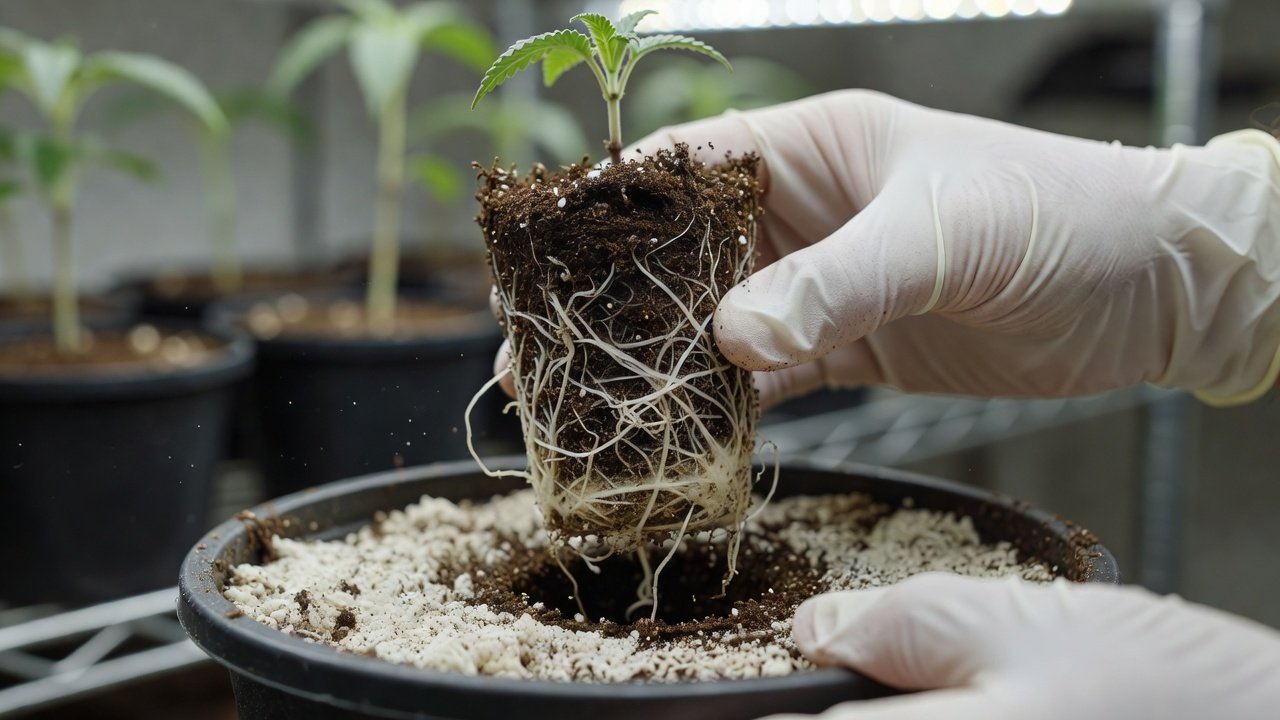
From about day three to day seven the cotyledons open and the first fine lateral roots form. The root ball is still tiny. A move is possible only if the entire plug of medium stays intact and the stem is never used as a handle. Between day seven and day fourteen, roots explore quickly. This is the only practical transplant window if you started in a small cell. The plug should be filled with white roots but not yet a tight spiral against the cup wall.
By days fourteen to twenty-one, many autos show preflowers. Vegetative bulk is already being traded for flower initiation. Disturbing roots in this window costs nodes and leaf area that will not be rebuilt, because the plant does not pause its clock while it re-anchors. After day twenty-one, during stretch and early bud set, transplanting almost always reduces final size. Photoperiod plants can be held in vegetative growth for extra weeks. An autoflower cannot. Root shock and a fixed finish date overlap, which is why a technique that is harmless for a tomato can be expensive here.
Direct-Sow Setup in the Final Container
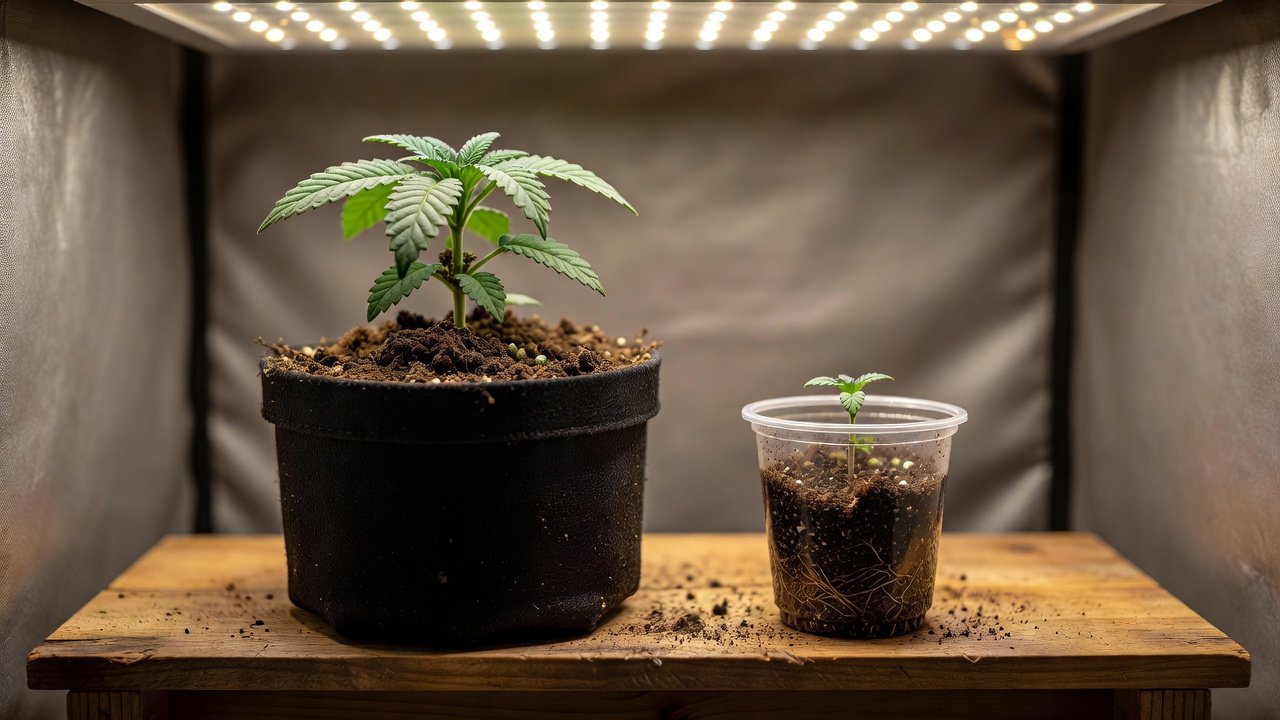
Direct sowing means the seed never moves. For most indoor autos, a final container of about eleven to nineteen litres (roughly three to five gallons) is enough. Outdoor plants and larger genetics often do better in nineteen litres or more. Fabric pots are a strong default because they air-prune roots and reduce the circling that plastic can encourage. Use a light, airy mix that is pre-moistened but not soggy, and place the seed about half a centimetre to one centimetre deep. Cover lightly. A humidity dome helps only for the first days in dry air, then remove it so the stem does not stay wet.
The advantage is simple: no root disturbance, an uninterrupted taproot, and no shock during the weeks when the plant should be stacking nodes. The downsides are practical rather than botanical. A large pot is harder to keep evenly moist without drowning a tiny root zone. The full footprint sits under the lights from day one. A failed germination also wastes a whole container of mix, which matters if you are testing a new pack.
A useful compromise inside a direct-sow pot is a small pocket of finer, lightly fertilised seedling mix in the centre, with the rest of the container filled with your main medium. Water in a ring a few centimetres from the stem, or mist the centre until roots reach outward. Do not bury the seed deep to “protect” it, and do not feed heavily in week one. Hot soil stunts autos just as surely as a late transplant. Label the pot with the strain and sow date so you are not guessing later whether a stall is age-related.
The Narrow Early Transplant Window
Starting in a small cup, peat pellet, or root plug can work, but only if the move happens before roots circle and before preflower. For most home setups that means roughly day seven to day twelve from sprout, sometimes stretching to day fourteen for a slower plant in a cool room. After that, the window closes fast. A solo cup that is root-bound by day ten is already late. Clear cups help because you can see roots at the wall. That sight is the signal to move, not a reason to wait for a free afternoon next week.
Water the starter the day before so the plug holds its shape. Prepare the final pot with a hole the size of the plug, not a loose crater you will collapse later. Slide the plug out without squeezing the stem. Set it at the same depth it grew at, backfill gently, and water lightly to settle air pockets rather than flooding the new pot. One move is the limit. Up-potting twice burns days the life cycle does not have.
The Royal Horticultural Society advises that disturbed roots must re-establish before top growth fully resumes. That pause is tolerable for long-season garden plants. Autos simply have fewer days to spend on it. If you cannot commit to checking the plug daily in week two, direct sowing is the safer default. Convenience transplants, the kind done when the grower finally has time, are the ones that show up later as tiny flowering plants.
Stunting Signs a Short Cycle Cannot Outgrow
A little droop on moving day can be normal. A stall that lasts is not. Watch for wilt that continues more than about forty-eight hours, new growth that stays pale, twisted, or frozen while older leaves look acceptable, and internodes that remain tight as the plant starts to flower at only a few nodes. Another classic failure is a root-bound plug that is still a dense cylinder weeks later, with new roots barely leaving the original shape. Yellowing from the bottom combined with a pot that stays wet is often overwatering after shock, not a feeding problem.
Preflowers on a plant that has only two or three real nodes are a warning, not a curiosity. Photoperiod growers can add vegetative time and grow out of a setback. Autos cannot. A seven-to-ten-day stall can finish the run thirty to fifty percent smaller than an undisturbed sister plant, because flowering has already claimed the calendar. That lost size is the reason this decision matters more than pot aesthetics.
Separate these signs from other early problems. Light burn shows on the top leaves closest to the lamp. Nutrient burn from a hot mix appears as crispy tips even when the plant was never moved. Outdoor hardening wilt is a climate response and belongs in a hardening guide, not in a pot-size debate. Do not stack stresses. A late transplant plus a sudden move outside is two shocks on a plant that can afford neither. If you grow in a short outdoor season, start with the timing advice in autoflower growing in cool climates, then still treat any indoor-to-final-pot move as an early, single event.
Head-to-Head: Final Pot Versus an Early Move
Read the two methods against the constraints that actually decide an autoflower harvest, not against generic seedling advice.
- Root disturbance: direct sow has none. An early intact-plug move is low risk. A late or squeezed transplant is high risk.
- Clock risk: direct sow is the lowest. A move inside the second week is moderate. Anything after preflower is high.
- Week-one moisture: large pots are easier to overwater. Small starters are easier to keep evenly damp, which is why propagation trays feel safer at first.
- Space and light: final pots claim tent space immediately. Cups let you run more starts under a small propagation light, then keep only the strongest.
- Failed seeds: cups make it cheap to resow. A dead seed in a five-gallon pot wastes medium and a reserved spot.
- Skill: direct sow forgives a busy schedule. Transplanting demands that you act when the roots are ready, not when it is convenient.
- Yield ceiling: for most home growers, undisturbed roots set a higher and more repeatable ceiling. A skilled early move can match it. A late move rarely does.
Seedling moisture basics from University of Minnesota Extension still apply: consistent dampness, not saturation, and enough air in the mix. Those rules do not change because the crop is cannabis. What changes is the penalty for getting them wrong during a move. General transplant charts assume you can wait for recovery. Autoflower charts should assume you cannot.
Which Method Fits Your Grow
Choose direct sowing if you already have tent space for final pots from day one, if a previous run was stunted after a move, or if you use a living soil or heavier mix you would rather not disturb. It is also the better choice for beginners who would rather learn moisture control than manage a deadline. A slightly slower first week in a big pot is usually cheaper than a perfect-looking seedling that stalls in week three.
Choose a small start and one early move if germination on a new pack is uncertain and you do not want several empty final pots, if propagation space is tight, or if you use plugs you can inspect and you will actually move them before day twelve. Experienced growers who check roots daily can match direct-sow results. The method fails when the cup becomes a waiting room.
Do not transplant after preflower, and do not up-pot in stages. Vigorous genetics tolerate a perfect early move better than a weak seedling tolerates any disturbance, so seed quality still matters. Our notes on selecting premium autoflower seeds cover what to look for before you commit a container. Canopy work is a separate decision. Once roots are settled, a screen or other training can wait; it should not be used to compensate for a plant that was set back while the plug was overdue.
The Practical Call for 2026
For most home growers, autoflower seeds should go straight into the final container. The life cycle is too short to budget a recovery week that photoperiod and vegetable guides quietly assume. Use a small starter only when space, unknown germination, or a dedicated propagation setup makes it clearly better, and move the intact plug before roots circle, usually inside the second week from sprout.
Judge success by the calendar and the canopy, not by whether the transplant looked neat on the day. Multi-day stall, flowering at a tiny size, and roots that never leave the original plug are yield already lost. Pick the method that matches your space and your willingness to act on time, then leave the roots alone for the rest of the run.